
Why is the Use of Pre-Partum Protein Feed Important in Sheep?
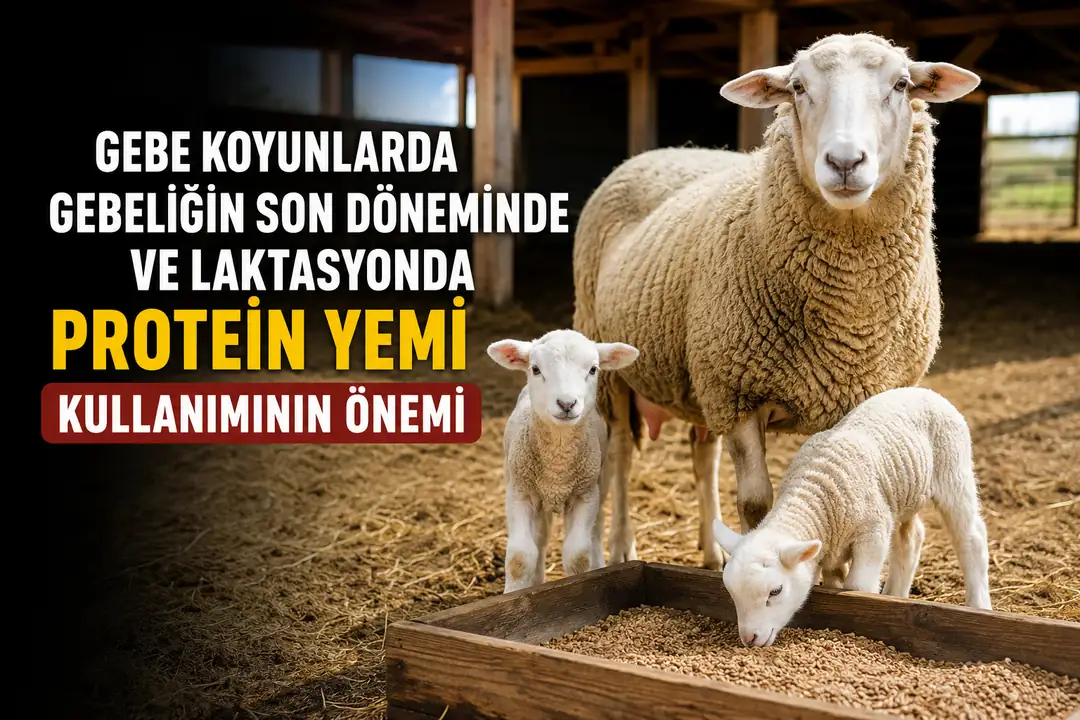
One of the most critical periods in sheep feeding is the final weeks leading up to lambing. During this period, both the nutrient requirements of the ewe increase and the development of the lambs in the womb accelerates.
Therefore, a proper and balanced feeding program must be applied during the final stage of gestation. Nutrition and feeds used during this period are of great importance in terms of birth weight, lamb vitality, milk yield during lactation, and the ewe’s post-partum recovery.
One of the issues producers must pay the most attention to during this critical period is meeting the ewe’s protein requirement.
The reason why protein requirements increase as lambing approaches is that the vast majority of fetal development in the womb takes place during the last 1/3 of gestation.
In addition, in twin or triplet pregnancies, the lambs in the womb develop rapidly. Consequently, the ewe’s requirements for protein, starch, minerals, and vitamins also rise.
If a pregnant ewe does not receive adequate and quality protein, she may be forced to use her own body reserves and may struggle to meet the needs of the developing lambs.
Therefore, the ration must be sufficient in terms of protein as the period of lambing approaches.
How Does Protein Feed Affect Lamb Development?
Protein is one of the fundamental building blocks of muscle and tissue development for the lamb in the womb.
Providing adequate protein during the final stage of gestation helps support the lamb’s development.
In underfed ewes, the risk of abortion or encountering weak lambs may increase. Especially in cold weather conditions, weak-born lambs have a lower chance of survival.
For this reason, the goal should be to obtain healthy and lively lambs.
Protein is Even More Important in Twin and Triplet Pregnancies
The nutrient requirements of a ewe carrying a single lamb are not the same as those of a ewe carrying twins or triplets.
In multiple pregnancies, since more lambs develop in the uterus, energy and protein requirements can increase significantly, especially in the final stage of gestation.
Therefore, the pregnancy status in the flock should be determined as much as possible, and the feeding of ewes carrying twins or triplets in particular should be arranged accordingly.
Applying the same feeding program to a ewe carrying a single lamb and one carrying triplets may not always yield the right results.
Does the Use of Protein Feed Affect Milk Yield?
After lambing, one of the ewe’s most important tasks is to provide her lamb with a sufficient amount of quality colostrum.
Especially in the first days after birth, it is of great importance that the lamb receives sufficient colostrum, which is first milk. We can achieve this through the quality protein source consumed by the ewe.
Especially in ewes fed with low-protein roughage such as poor-quality straw, meeting requirements solely through roughage can become difficult.
At this point, a pre-partum protein-supported concentrate feed with appropriate characteristics can be used.
However, the feed amount must be determined based on roughage quality, the ewe’s live weight, litter size, and the general condition of the flock.
Therefore, the important thing is not to use high-protein feed, but to reach the protein level appropriate for the ewe’s needs.
The balance of calcium, phosphorus, magnesium, and other minerals is also important in ewes approaching lambing.
Therefore, answers should be sought not only to the question “how much protein feed should I use?”, but also to “how balanced is the ewe’s total ration?”.
Let us not forget that;
A healthy lamb, a strong ewe, and good milk yield are shaped not after birth, but by proper nutrition applied before birth.