5 Checks Before Culling a Cow That Fails to Conceive
Most farms put a cow up for sale if she does not conceive after three inseminations. However, the cause is sometimes missed heat, sometimes a disrupted energy balance after calving, and sometimes a vitamin and mineral deficiency in the ration. We have listed five areas to check before selling.
The phrase “This cow isn’t catching, let’s sell her” is the end of the road for that cow in most barns. The calculation seems simple: she is being milked but not conceiving, and she eats feed every passing month. But not every cow that fails to conceive does so for the same reason. Some are truly sick, some are due to management, and some are not conceiving due to deficiencies in the ration. You cannot fix the first two groups with feed. It would be a pity to sell the third one just because she “isn’t catching.”
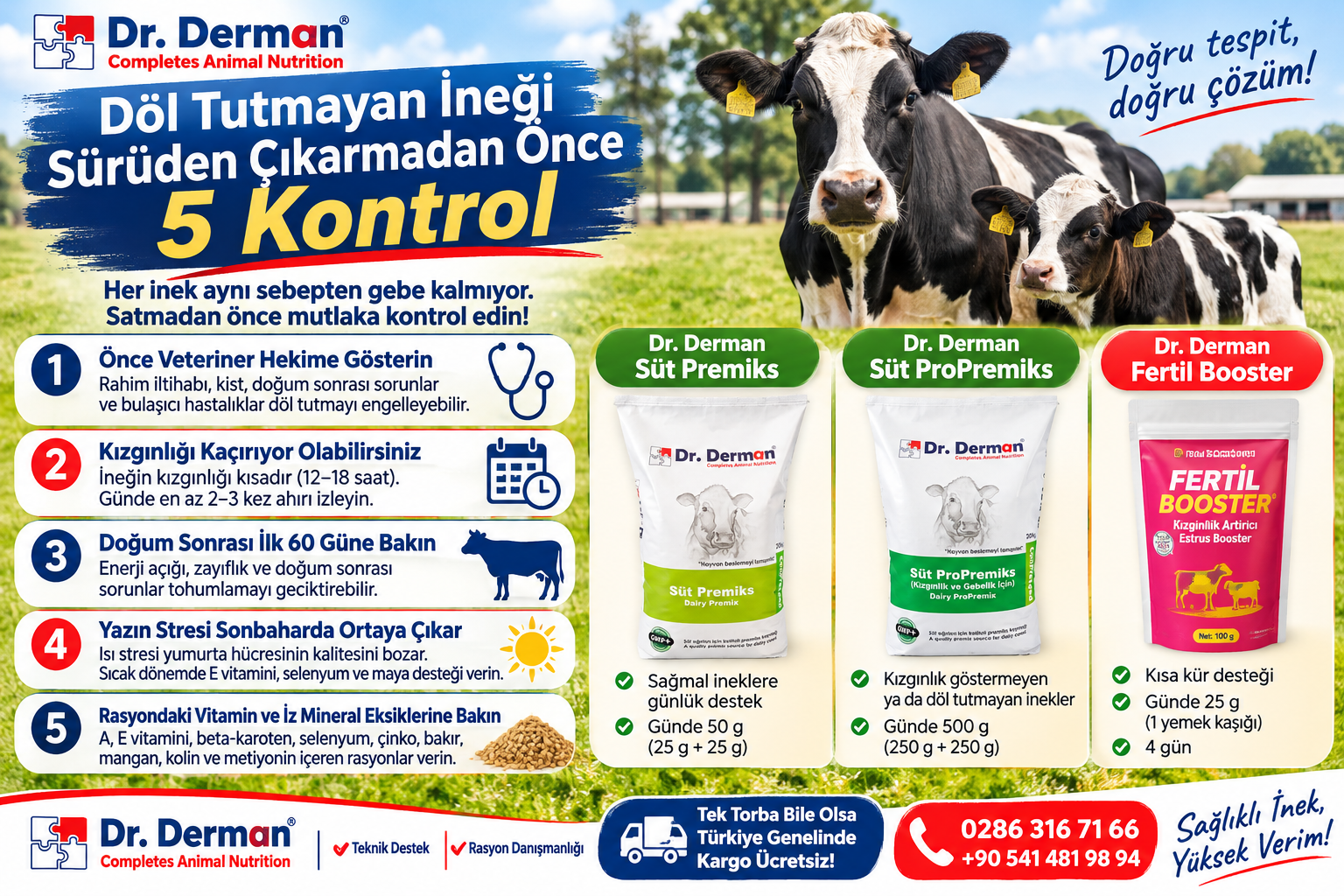
1. Consult a Veterinarian first
Problems such as uterine infections, ovarian cysts, or retained placenta after calving cannot be cured with feed. Giving vitamins or premixes to such a cow is a waste of time, and in the meantime, heat cycles pass. If the heat interval is much longer or shorter than 21 days, or if there is discharge from the uterus, have her examined without fail. Infectious diseases such as Brucellosis, IBR, and BVD can also be the cause of failure to conceive. These are monitored at the herd level together with a veterinarian, not just in a single animal.
2. You might be missing the heat
A cow’s heat is short, lasting around 12-18 hours. Just taking a quick look while feeding in the morning and evening is not enough. Observe the barn calmly for twenty to thirty minutes at least two or three times a day. In high-yielding cows, symptoms can be weak, which is why some heats go completely unnoticed.
Write down the heat and insemination dates in a notebook and mark 21 days later. Inseminate a cow seen in heat in the morning in the evening, and one seen in the evening the next morning. Have a pregnancy check done approximately 35 days after insemination.
3. Look at the first 60 days after calving
In the first weeks after calving, a cow cannot eat as much feed as the milk she produces. She burns the fat in her body and loses weight. The greater this energy deficit, the later the first heat arrives. A cow that enters calving too fat or too thin, or loses condition rapidly after calving, will conceive late. Post-calving problems such as milk fever, ketosis, and retained placenta also delay insemination. In most operations, the first insemination is performed 60-70 days after calving. Until that day, the cow must be eating a healthy and balanced diet.
4. Summer stress appears in autumn
Heat stress experienced during the summer heat impairs the quality of the egg cell, and its effect can last for several months. If you are saying “The weather has cooled down, but she still isn’t catching,” the cause may be this burden remaining from the summer. During hot periods, supplements such as Vitamin E, selenium, niacin, and live yeast are usually added to the ration.
5. Check for vitamin and trace mineral deficiencies in the ration
Nutrients such as vitamins A and E, beta-carotene, selenium, zinc, copper, manganese, choline, and methionine are required for clear heat and healthy functioning of the ovaries and uterus. Mixed rations are often insufficient. The level of beta-carotene and vitamins drops significantly in roughage that has been stored in the warehouse for a long time. Giving vitamins via an injectable route from time to time is neither as easy nor as balanced as providing them regularly in the ration every day.
Which product for which cow?
Dr. Derman has three products that support reproduction for dairy cattle, and they are often confused with each other. All three are feed additives, not drugs. All three must be thoroughly mixed with feed before being given. There are no hormones or antibiotics in Süt Premiks and Süt ProPremiks. Fertil Booster also contains vitamins, minerals, lysine, and methionine, not hormones.
| Product | For whom | Amount | Duration |
|---|---|---|---|
| Dr. Derman Süt Premiks (20 kg) | Milking cows in the herd; daily support against summer stress, ketosis, and milk fever risk | 50 g per day (25 g morning, 25 g evening) | Every day |
| Dr. Derman Süt ProPremiks (20 kg) | Cows that do not show heat, do not conceive despite several inseminations, or experience early embryo loss | 500 g per day (250 g morning, 250 g evening) | 20-40 days |
| Dr. Derman Fertil Booster (100 g) | Short course for cows that do not show signs of heat or do not conceive | 25 g per day (1 tablespoon), on top of the feed | 4 days |
Süt Premiks is a basic support given to the entire herd. Süt ProPremiks and Fertil Booster are courses applied to problematic cows. First, have the examination in item 1 performed. If there is a uterine infection, cyst, or an infectious disease, these products will not be the solution; that problem must first be resolved by a veterinarian. For results, it is necessary to wait at least one or two heat cycles, i.e., 21-42 days.
Conclusion
It is easy to sell a cow, but expensive to buy a pregnant heifer to replace her. First examination, then heat tracking, then the post-calving period and the ration. After following this sequence without skipping, it would be a more correct decision to sell a cow that still does not conceive. If you do not know which product to give to which cow, you can consult our team. For free feeding consultancy;
Our information line: 0286 316 71 66 / 0541 481 98 94